

Air Force launches new GPS satellite

Upgraded orbiter to deliver greater accuracy

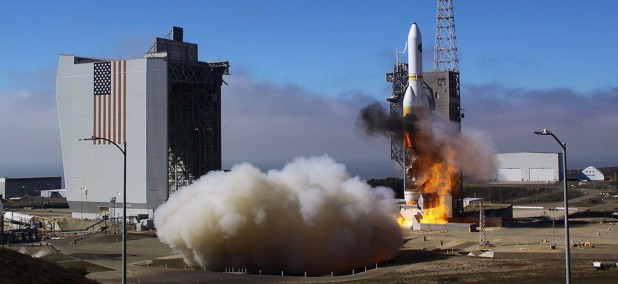
The seventh of eight enhanced second-generation global positioning satellites (GPS) blasted into space early on March 24 from Cape Canaveral Air Force Station, Fla. The two-ton GPS satellite, designated GPS IIR-20(M), flew on a three-stage Delta II rocket and reached orbit after a 68-minute flight.

This satellite is the penultimate of an eight-block program to replenish GPS satellites for the military as well as for civilian use. Since it launched the first GPS satellite in 1978, the Air Force has periodically upgraded the constellation with new capabilities.

The features built into this latest program block include two new military signals for improving accuracy, increased signal power to receivers on the ground, enhanced encryption, anti-jamming capabilities and a second civil signal to provide dual frequency capability with better resistance to interference. In addition, this orbiter carried a research and development demonstration payload for transmitting a third civil signal known as L5.

“Every year we have made the GPS signal better, every year the accuracy of the system has improved," said Gen. Robert Kehler, the Air Force Space Command commander. "And that is what is going to continue to happen."

Designed to operate for 10 years, GPS satellites orbit the Earth every 12 hours and provide a key capability for military situational awareness platforms such as Blue Force Tracking. A third generation of GPS satellites is set to begin operations in 2013.

The March 24 launch had been slated for June 2008, but problems with the Delta II rocket kept the orbiter grounded for almost a year. Delta II rockets are near the end of their life cycle, having first blasted off 20 years ago. They were designed in the wake of the 1986 Space Shuttle Challenger disaster, when the Air Force needed alternate means to lift hardware into space. The last Delta II ever to hold an Air Force payload is set to carry the eighth enhanced second generation replenishment GPS satellite in August.

Although it was launched from an Air Force facility, the rocket belonged to a private-sector rocket launch services consortium named the United Launch Alliance, a joint venture formed in 2006 between Boeing and Lockheed Martin. The two companies previously competed to launch government payloads, but consolidated when it became clear that a commercially-viable rocket launch market might not exist.

The United Launch Alliance had tried only days earlier, on March 18, to launch the Air Force’s second Wideband Global Satcom into space using an Atlas V rocket at Cape Canaveral, but scrubbed it following the discovery of an upper-stage liquid oxygen leak.

About the Author

David Perera is a special contributor to Defense Systems.

Reader Comments

Tue, Apr 10, 2012 Carol Stamp

Well, GPS systems seem to be the main point for Air Forces. But I also think that navigation satellites came in use long before 80s. Technical progress is going on and on and navigation systems continue being developed which can be only admired and appreciated))

Sat, Jul 11, 2009 jco

NavSat was "started" waaaaaaayyyy back in the late 50's and early 60's by John's Hopkins University Applied Physics Laboratory for the US Navy, right after Sputnik. The Transit 1A was launched in Sept '59 but failed to reach orbit. Transit 1B was successfully launched in Apr 03, 1960 and it entered service in 1964. The satellites were known as OSCAR and NOVA and were put in orbit at about 1100 Km with a period of 106 minutes. There were 10 satellites in TRANSIT and you needed at least five for reasonable global coverage. All of this is covered inhttp://en.wikipedia.org/wiki/Transit_(satellite) for your leisurely reading pleasure. BTW, TRW built a completely new computer, the AN/UYK-1 (TRW-130) with rounded corners to fit through the hatch of a Lafeyette Class SSBN submarine in about '62 - '63. Designed by Lowell Amdahl of Stanford fame (brother to Gene Amdahl or Amdahl computers) it was totally antiquated by Commadore-64 technology in the early 80's but was redesigned several times bringing it to the leading edge of technology with one of the final versions being the 32-bit AN/UYK-43 in the mid 80's. SDG jco

Fri, Apr 3, 2009 JT USAF

There were various incarnations of SATNAV before GPS came out. Don't forget, the standard GPS definition for the planet didn't come out until 1984 (hence, WGS-84 standard modern lat/lon datum). LORAN was common until GPS, but LORAN uses radio stations not sats. I'd like to see the world say "thanks" at least since the constellation was built and paid for by the US but we let the world use it for free, just like the internet which the DOD originally built in 1967.

Wed, Apr 1, 2009 Ray

The article seems to say that GPS was started in 1978 by the Air Force, but we were using navigation satellites in the early 70's on Navy ships and I worked at Point Mugu at the Navy monitoring and injection station during 1976 and 1977. The NAVSATs (the acronym in use during that era) were launched from Vandenberg, so the Air Force was involved back then. Satellite based positioning systems sure have come a long ways, but in many respects it is still the same techniques.

Please post your comments here. Comments are moderated, so they may not appear immediately after submitting. We will not post comments that we consider abusive or off-topic.

Your Name:(optional)
Your Email:(optional)
Your Location:(optional)
Comment:
Please type the letters/numbers you see above

Amber Corrin's Inside DOD Blog

Webcast

  • Using Big Data Tools to Manage the Deluge of ISR Data

    Defense IT professionals and other data-driven agencies are turning to new methods to capture, process and analyze new volumes of data and insure they are maximizing its value. This webinar will explore how cloud tools and infrastructures have created new opportunities to share, collaborate and accelerate decision making across agencies and geographic regions. A Government expert will explore the broader ISR situation and challenge as it exists in the military today, and how Big Data tools can be used to tame that data and make it usable to the warfighter on a real-time or near-real-time basis. Read more